

Managing Partner
Carlsquare Private Equity Insights: Q2 2026
6 aug 2026
After a record-setting Q2 2026 in deal value, driven by a single landmark exit, underlying transaction volumes have yet to follow, leaving H1 2026 with a more cautious tone. Yet significant structural forces continue to create strong tailwinds for PE deal activity, and the conditions for a meaningful acceleration in the second half of 2026 are increasingly in place.
Executive Summary:
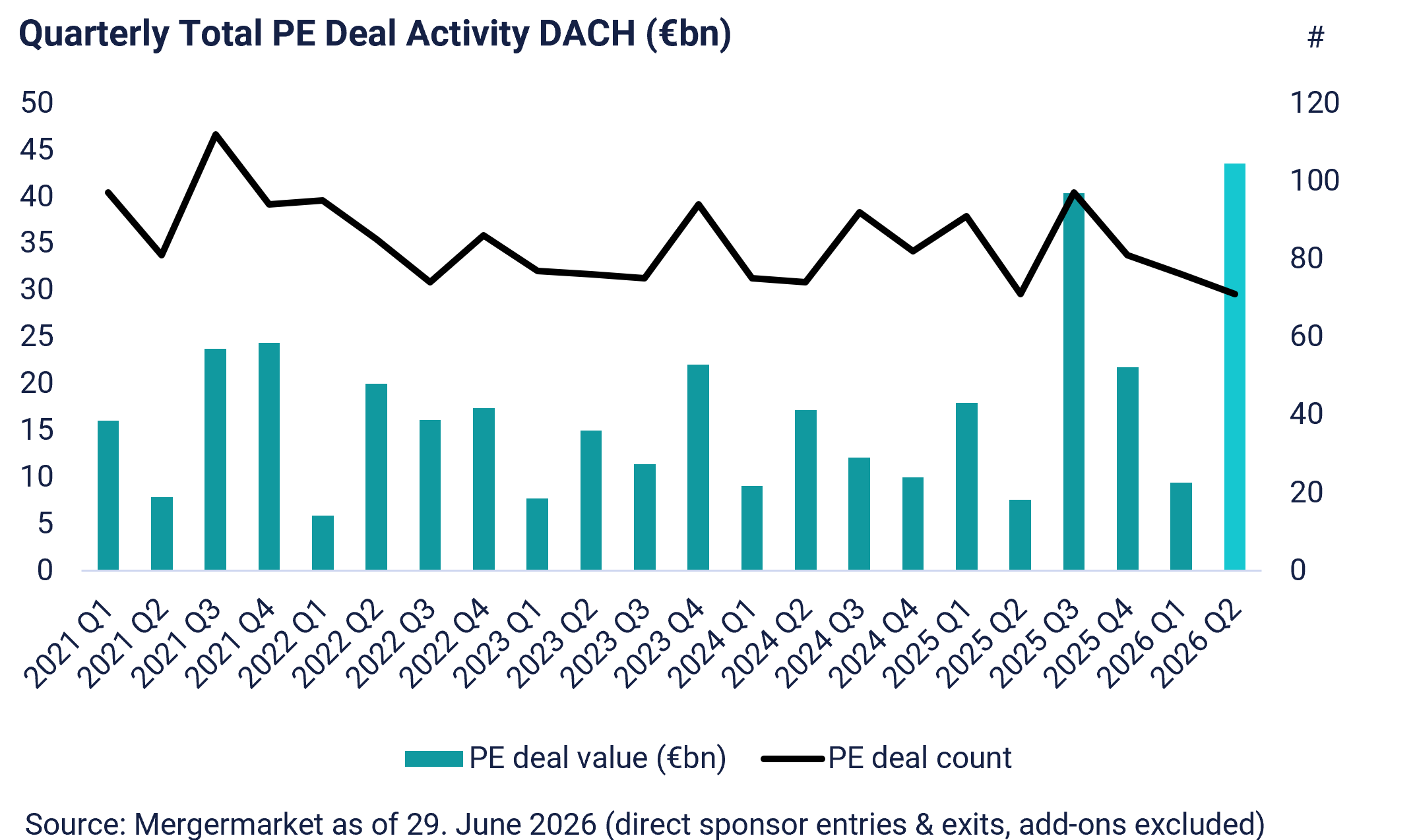
- Q2 2026 pulled in two directions: record PE deal value of €43bn on slightly declining deal count, €29bn of it from the single landmark TKE exit. Fewer deals, higher tickets.
- DACH Healthcare M&A remains a market of few, but contested assets: deal flow remains thin and concentrated on defensible, growing, sticky businesses. For those, sponsors still pay above 12x EBITDA.
- The European debt market rebounded sharply in Q2 2026: tighter spreads, robust issuance, and a clear shift back to borrower-friendly conditions. The debt market’s answer to unlocking liquidity without adding leverage: working capital financing.
- In our Partner Interview, we sat down with Hannes Rumer, Co-Managing Partner at Egeria, to discuss Egeria’s selective origination strategy, its oversubscribed €1.25bn fund, what AI really changes for PE, and his outlook for DACH in H2 2026. Read the full conversation here.
1. Private Equity Market Update: DACH
Q2 2026 Review:
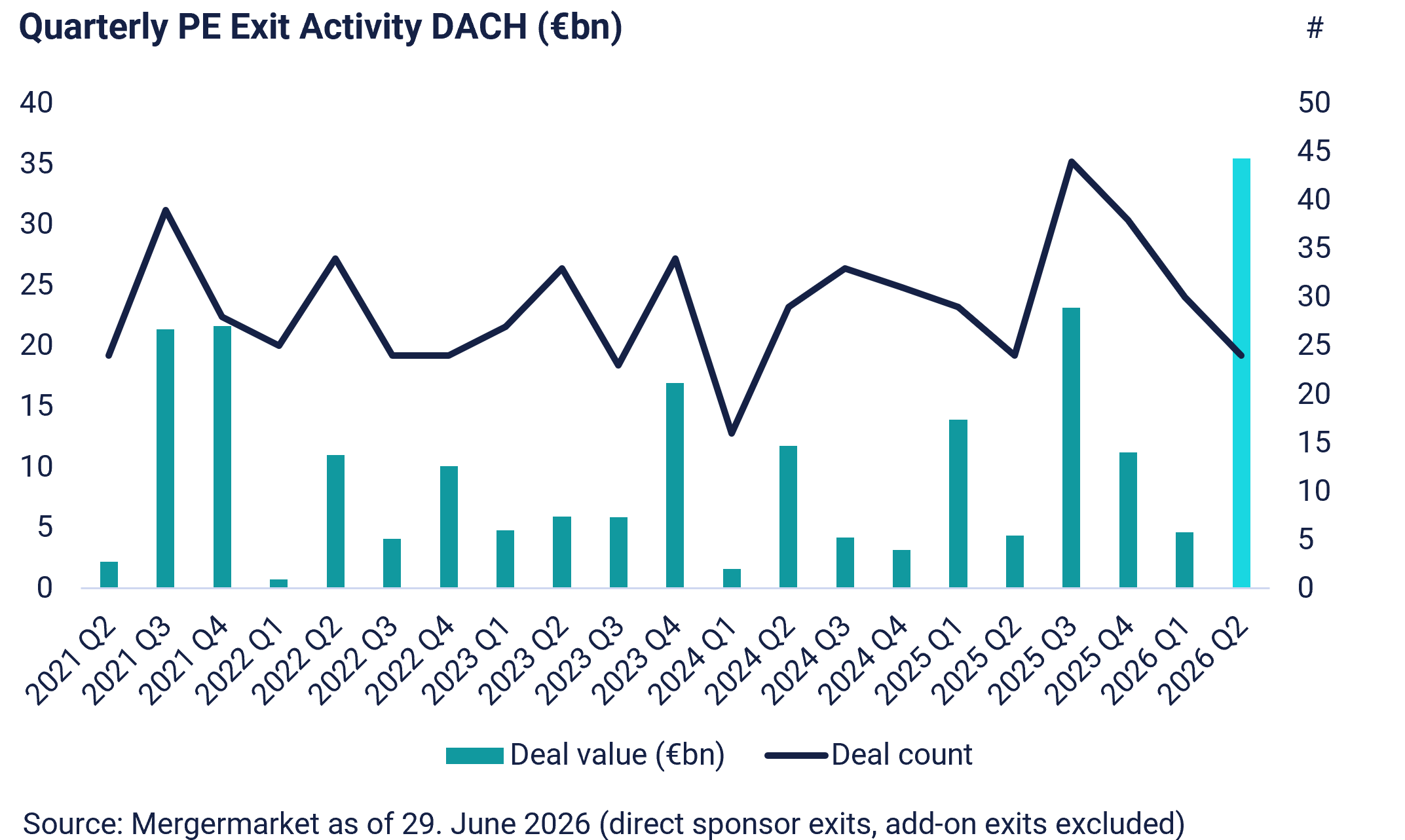
Q2 2026 presented a bifurcated picture. The number of PE deals fell from 76 in Q1 to 71 in Q2, while the number of PE exits declined from 30 to 24 over the same period. In terms of deal value, however, Q2 proved to be a record-setting quarter with €43bn in total deal value and €35bn in exit value. These numbers were, however, largely skewed by Advent and Cinven’s landmark €29bn exit from TK Elevator, marking one of the largest European PE exits of all time. As an exit, TKE is reflected in both the total deal value and the exit value figures below. This development reflects a broader trend: fewer transactions, but on a larger scale, leading to a concentration of deal value in selected large-cap transactions.
Excluding the TKE deal, total PE deal activity in H1 2026 nonetheless proved resilient, with a deal count down only 9.3% (162 in H1 2025 compared with 147 in H1 2026). The exit side, however, presents a mixed picture. While the exit count is broadly in line with the previous year, the trajectory of exit values depends entirely on the TKE deal. If the transaction is included, the first half of 2026 significantly outperformed H1 2025; if not, 2026 lags behind.
For the entirety of 2026, it remains to be seen whether H2 can deliver higher deal activity. History is on the market’s side, as the second half tends to outperform the first.
Outlook H2 2026:
Still, two factors might temper deal activity in the second half of 2026: political and economic uncertainty, and the growing disruptive impact of AI.
The ongoing geopolitical conflicts in Ukraine and the Middle East, together with interest rate volatility and inflation concerns, create a challenging environment for PE firms. At the same time, rapid advances in AI are widening valuation gaps for businesses perceived to be at risk of disruption. This in turn makes it harder for PE firms to exit their portfolio companies, particularly in the software sector. However, as Armin Sieber pointed out in a recent PitchBook article: “If you have a really good asset, you may still be able to achieve a good price.”
The structural drivers we flagged in our Q1 Newsletter are all still in place. Two quarters on, however, they have not yet translated into a higher deal count, which makes this a question of timing rather than of demand:
- European dry powder has accumulated to a historically high €459bn, making capital deployment imminent.
- Holding periods in DACH lengthen further, aligning with the broader trend across Europe, where one-third of assets remained in PE portfolios for longer than 7 years.
- LP pressure for distributions continues to grow, and it cuts both ways: 20% of European LPs are trimming PE allocations because of liquidity strains or lower return expectations, which forces GPs to return capital before they can raise again.
In combination, these drivers point to meaningful momentum for DACH PE deal activity in H2 2026, with the pressure to transact mounting, as unspent capital and ageing portfolios can only be held for so long. Additionally, Carlsquare is still seeing a high volume of pitch activity, which may indicate stronger deal flow in the second half of the year. That said, momentum will not be evenly distributed, with some sectors set to attract markedly more investor focus than others, as we explore in this edition’s Sector in the Spotlight.
What this means for H2 2026: Our base case is a higher deal count in H2 than in H1, but a lower headline deal value, since Q2’s record was a single-asset event and is unlikely to repeat. For sellers of defensible, growing assets, the window is open now: buyer appetite is concentrated, and competitive tension is achievable where the asset story holds. For sellers of generic, high-multiple or AI-exposed businesses, waiting is unlikely to help; the valuation gap is structural rather than cyclical. For buyers, the discipline of the past two quarters is paying off. But the assets worth paying up for will be contested, so speed and preparation decide outcomes more than price alone.
Sources: Mergermarket (as of June 29th, 2026); Gain “The State of European Private Equity Report”; PitchBook (as of June 23rd, 2026); Carlsquare Research
2. Sector in the Spotlight: Healthcare
Deal flow in DACH Healthcare M&A stayed thin through the first half of 2026, but the few assets that did come to market drew intense attention, especially from financial sponsors. We sat down with our Head of Healthcare, Caspar Graf Stauffenberg, to unpack what shaped the market, which sub-sectors and KPIs investors are rewarding, and what H2 2026 could have in store.
How would you summarize H1 2026 for Healthcare M&A in the DACH region? What were the key factors shaping this environment?
Deal flow remained limited but the few assets that came to market drew a high level of attention, particularly from financial sponsors. Given the regulatory complexity of healthcare markets and the very specific dynamics of the many niches and sub-niches, it remained challenging to maintain competitive tension all the way through to the end of a process. We saw both broken deals and outcomes closing at very high valuations, underlining a selective environment in which high-quality assets continue to command strong interest.
This is consistent with the wider picture: after DACH private-equity volumes grew around 15% in 2025, deal conversion slowed in early 2026 as geopolitics and financing costs bit, with activity concentrating in fewer, larger, higher-quality processes rather than a broad recovery. Healthcare has held up as one of the more defensive corners of that market.
Earlier this year, Carlsquare and Gimv co-hosted a pre-event at DMEA 2026 in Berlin, uniting healthcare entrepreneurs, investors and industry experts. What were your main takeaways?
Digitisation and automation are the single most important driving force in transforming an increasingly inefficient healthcare system. Innovative disruptors who prove they have a viable, commercially proven business model are sought after, by financial and strategic investors alike.
Which sub-sectors within Healthcare and Life Sciences are currently attracting the strongest investor interest, and why?
Specialised IT service providers, tech-enabled services for payers and healthcare providers, and healthcare infrastructure. All of them are seen as growth models with a rapidly growing TAM and a high degree of customer stickiness.
The pricing backs this up: in Europe’s private mid-market, healthcare is consistently among the highest-valued sectors, and financial sponsors are paying a clear premium over strategic buyers for scarce, defensible assets.
Which KPIs make a healthcare business appealing to investors?
For transactional service models, the Rule of 40 applies. More generally, customer churn should be very low and the EBITDA margin above 20%, as both signal a high degree of defensibility. A lower EBITDA margin is only accepted where there is strong top-line growth.
Do you see a mismatch between seller expectations and buyer discipline? What are the key factors driving valuation?
Sellers are still expecting high EBITDA multiples. Many sponsors bought at high multiples before Covid, but buyers have since become more cautious — interest rates rose after 2021 and many fast-scaling business plans did not come true.
Buyers are willing to pay EBITDA multiples above 12x if and only if:
- there is trust that the regulatory environment, healthcare reform legislation in particular, will not damage the business model;
- there is trust that true and genuine growth is plausible; and
- the business shows a high degree of stickiness and low to zero customer churn.
The comforting hypothesis around AI: highly regulated markets are believed to be less vulnerable to sudden substitution by agentic AI.
Looking ahead to H2 2026, which themes do you expect to have the greatest impact on Healthcare and Life Sciences M&A in the DACH region?
In Germany, healthcare and nursing reforms will have been decided and can be factored in. This reduces uncertainty and provides a more reliable valuation framework. Greater stability in the overall economic environment and in interest rates should also encourage sponsors to bring overdue assets to market — assets that have so far been held back for the reasons above.
What does this mean for investors?
Record dry powder and PE dominance mean quality DACH healthcare assets will stay contested; sponsors are paying a clear premium over strategics for defensible, recurring-revenue models. For owners of such businesses, regulatory clarity in H2 could open a genuine window to come to market at the top of the range. For buyers, discipline still pays: the assets that clear above 12x are the ones where regulation, growth and stickiness all line up.
Carlsquare View: High-quality assets still command strong interest, and with regulatory clarity from German healthcare and nursing reforms and steadier interest rates, H2 2026 could see sponsors bring overdue assets to market that they have held back until now.
Our two most recent Carlsquare Healthcare deals:
Carlsquare advised Schwabe Group on its strategic investment in NeuroNation
Carlsquare advised DENA A/S on the sale of BiopSafe to MedCap
3. Financing Market Update from Carlsquare Debt Advisory Team
The European leveraged loan market regained strong momentum in Q2 2026, with tighter spreads, robust issuance volumes and a clear return to more borrower-friendly conditions. However, interest rate expectations among market participants remained broadly stable, as the ECB raised rates by 25 bps while the Bank of England maintained a more dovish stance amid ongoing geopolitical uncertainty.
In this quarter’s newsletter, our Debt Advisory team is introducing working capital financing as an efficient instrument in the mid-market financing toolkit — and in the current environment one relevant instrument to receive short-term financings. For businesses with meaningful receivables, inventory, or payables flows, it offers a way to unlock balance sheet liquidity without permanently increasing leverage or consuming headroom under existing senior facilities. The right instrument depends on the company’s operating model, asset quality, and cash conversion cycle, but the most common use cases include:
- Balance sheet efficiency
- Growth financing without adding term debt
- Seasonal liquidity management
- Supply chain resilience
- Capital structure optimisation
4. Carlsquare PE Conversations: Hannes Rumer, Co-Managing Partner at Egeria
Egeria was named one of the most active financial investors in the German mid-market in 2025. We spoke with Hannes Rumer about how those deals came together, how the DACH pipeline looked in H1 2026, and where he sees AI creating value rather than noise.
Key Takeaways
- Where the deals come from: primaries with founders and family entrepreneurs (CPRO, Junge) and complex carve-outs (Implico), both won over long lead times, not in auctions.
- Aligned capital: almost half of Egeria 6 comes from Egeria itself and from entrepreneurs who have worked with the firm before; the latest fund closed oversubscribed at €1.25bn.
- Value creation in practice: at Implico, profitability almost doubled organically within 18 months, with global add-ons now in preparation.
- AI, soberly: hardly any portfolio company where AI threatens the core business model, mostly efficiency upside, plus a group-level venture in AI humanoid robotics.
- Where the caution sits: generic high-multiple software and knowledge-based models, where uncertainty around exit ability alone is a problem.
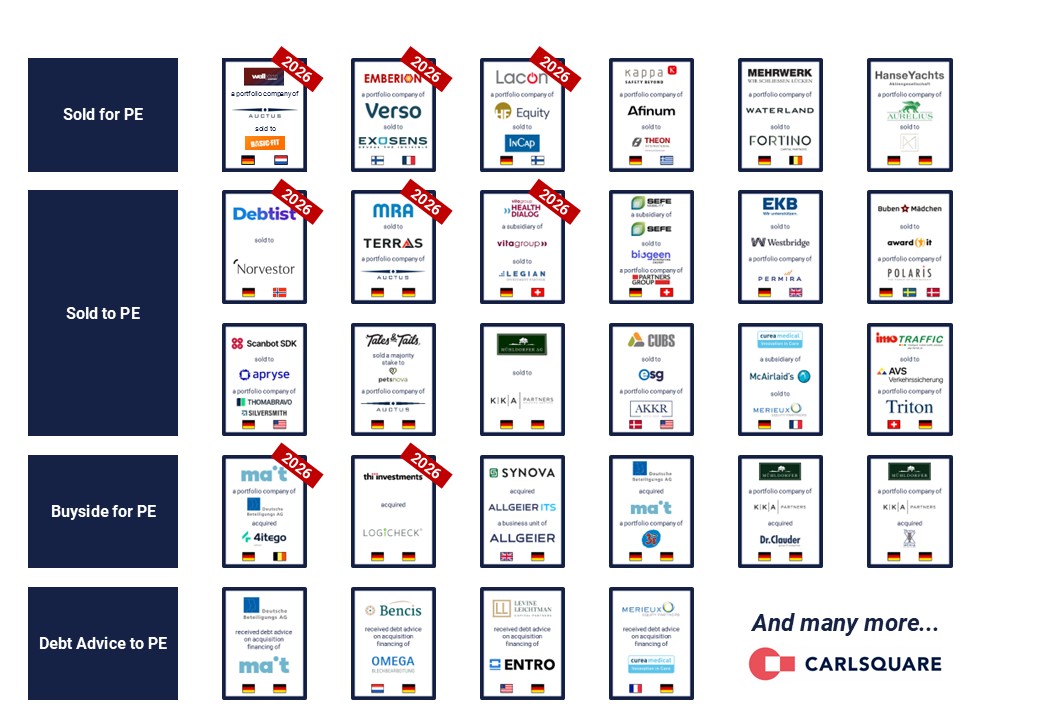
Recent Carlsquare Private Equity Deals
For any questions feel free to reach out to our authors Armin Sieber, Head of Financial Sponsor Coverage or Caspar Graf Stauffenberg, Managing Partner & Head of Healthcare.



Managing Partner and Head of Debt Advisory
Liknande Insights