


Managing Partner
AI in Healthcare: From Pilots to Platforms
3 Nov 2026
Our latest report looks at pressure on European healthcare systems, regulation and valuations in digital health M&A.
Executive Summary
Europe’s healthcare systems are under structural strain. Shortages of physicians and nurses affect many countries, and without reform, Germany’s statutory health insurance funding gap grows from EUR 15.3bn in 2027 to EUR 40.4bn in 2030. That pressure is pushing efficiency up the agenda. Doctors spend 36% of their working day on tasks other than treating patients, which is why ambient AI documentation is among the most mature areas of digital health.
Digital health is taking a larger share of European healthcare deals. Its share of deal count rose from 7% in 2021 to 10% in 2026 YTD, and its share of disclosed deal value reached 13%. For European digital health M&A, the pooled five-year median EV/Revenue is 4.81x, and the median multiple has risen from 3.8x at its 2023 low to 5.6x.
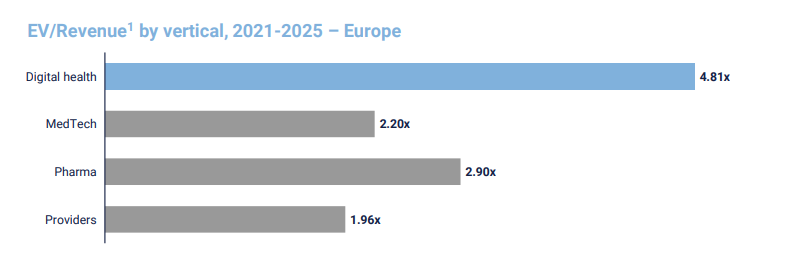
Market snapshot: How do digital health valuations compare with pharma, medtech and healthcare providers in Europe?
Digital health sits at the top of the range. Its median revenue multiple is roughly twice that of medtech and providers, and well above pharma. Pharma comes next, followed by medtech, with providers at the bottom.
Market regulation: Which healthcare AI applications face the strictest EU rules, and when do the main obligations start?
Clinical AI, such as radiology interpretation, pathology slide scanners and automated emergency triage tools, falls under the high-risk rules. It must navigate both the EU AI Act’s data governance rules and medical device requirements. Administrative tools, such as scheduling software and chatbots, face lighter obligations. Chatbot transparency rules apply from December 2026, and mandatory third-party conformity assessments for high-risk AI software integrated as medical devices start in August 2028.
Digital health innovations: What are the six digital health technologies transforming healthcare?
| Technology | How it creates value |
|---|---|
| AI-powered documentation | Ambient AI dynamically contextualizes patient data, directly alleviating structural workforce shortages |
| Integrated workflows | AI is moving into daily clinical and admin processes, where value depends on sustained use rather than pilots |
| Connected care | Care reaches patients at home, through physiotherapy and remote monitoring, reducing reliance on hospital visits |
| Digital therapeutics | Prescribable software treats conditions directly. Germany’s DiGA reimbursement scheme is a leading model for adoption |
| AI in R&D | AI accelerates early discovery, while streamlining clinical testing and approval processes to reduce time and development costs |
| Interoperable health data | FHIR-based data exchange (Fast Healthcare Interoperability Resources) supports scaling AI and connected care |
Key Takeaways
- Platforms are replacing point solutions: Digital health is moving from standalone tools to systems built into core clinical software such as EHRs and imaging.
- Admin work is the quickest win: Doctors spend 36% of their day on non-patient tasks, and documentation tools are already showing measurable time savings.
- Investors are paying up: Digital health accounts for 13% of European healthcare deal value and trades at a 4.81x median EV/Revenue, well above pharma and medtech.
- Regulation will favour scale: EU high-risk rules and rising compliance costs favour established, CE-marked platforms and are likely to drive consolidation.
Interested in M&A or Financing Opportunities in Digital Health?
Carlsquare’s team advises digital health companies, entrepreneurs, and investors across Germany and Europe, providing M&A advisory, growth equity, and debt financing for companies building the infrastructure of tomorrow’s healthcare system.
See our latest Healthcare deals.

Similar Insights