

Managing Partner
EBITDA in a Company Sale: Calculation, Multiples and Adjusted EBITDA
29 okt 2026
Anyone planning to sell their company will sooner or later have to deal with EBITDA. It is one of the most important figures in a valuation and therefore has a direct impact on the achievable purchase price. In practice, company value is often derived by multiplying adjusted EBITDA by a valuation multiple. For established mid-sized companies, this multiple is often around 6.0 to 7.0x as a benchmark.
Sellers who calculate their EBITDA properly, adjust it transparently and present their true earnings power convincingly often influence the purchase price more than they would by negotiating a higher multiple.
Based on our experience in M&A practice, this article shows which adjustments are possible, which multiples are common in different industries and what difference this can make in real transactions.
Key takeaways
- EBITDA stands for earnings before interest, taxes, depreciation and amortization. It shows a company’s operating earnings power independent of financing, tax burden and investment policy.
- In a company sale, EBITDA is one of the most important value drivers. In practice, company value is often calculated as a multiple times EBITDA.
- What usually matters is not EBITDA as reported in the annual financial statements, but adjusted, normalized EBITDA. One-off effects, private expenses and costs that will cease after the transaction are removed.
- Buyers often accept well-founded adjustments more readily than a higher multiple. A documented adjustment calculation is therefore often the most effective lever for a higher purchase price.
- In Carlsquare’s experience, a base multiple of around 6 to 7x EBITDA serves as a benchmark for established mid-sized companies. Size, growth, margin and market position lead to premiums or discounts.
What is EBITDA?
EBITDA is a company’s operating result before interest, taxes, depreciation and amortization. The metric disregards how a company is financed, where it pays taxes and how much it has invested in the past. What remains is the profit generated by the operating business.
The abbreviation stands for earnings before interest, taxes, depreciation (on property, plant and equipment) and amortization (on intangible assets such as software, patents or goodwill).
Because EBITDA excludes these factors, companies with different capital structures, tax situations and depreciation policies can be compared more easily. This makes it a key reference figure in company valuations and mid-market transactions. Among earnings-based metrics, a multiple based on a figure close to cash flow, such as EBITDA, is considered particularly meaningful.
How do you calculate EBITDA?
EBITDA can be derived from the income statement. The most common approach starts from net income:
EBITDA = net income + income taxes + interest expense (less interest income) + depreciation and amortization
Alternatively, you can start from EBIT: EBITDA = EBIT + depreciation and amortization.
A simplified example:
| Item | Amount |
|---|---|
| Net income | EUR 1.2 million |
| + Income taxes | EUR 0.5 million |
| + Net interest result | EUR 0.3 million |
| = EBIT | EUR 2.0 million |
| + Depreciation and amortization of tangible and intangible assets | EUR 0.8 million |
| = EBITDA | EUR 2.8 million |
Dividing EBITDA by revenue gives the EBITDA margin. With revenue of EUR 20 million, EBITDA of EUR 2.8 million corresponds to a margin of 14 percent. The margin is an important indicator of profitability and affects the level of the valuation multiple. In separate articles, we cover how margin and EBITDA feed into the company valuation and what role they play in the process of selling a business.
What is the difference between EBIT and EBITDA?
The difference lies in depreciation and amortization. EBIT (earnings before interest and taxes) takes depreciation and amortization into account, EBITDA does not. EBITDA is therefore always at least as high as EBIT.
EBIT is particularly suitable for companies with high investment requirements, for example in mechanical engineering or manufacturing, where depreciation reflects a real, recurring expense. EBITDA, on the other hand, is the standard metric in M&A transactions and among financial investors.
The distinction matters for valuation: since EBITDA is higher than EBIT, EBITDA multiples are lower than EBIT multiples for the same company value. Multiples should therefore not be applied to the other metric.
What role does EBITDA play in a company sale?
In a company sale, EBITDA is a key driver of company value. In practice, enterprise value is often determined using the multiples method:
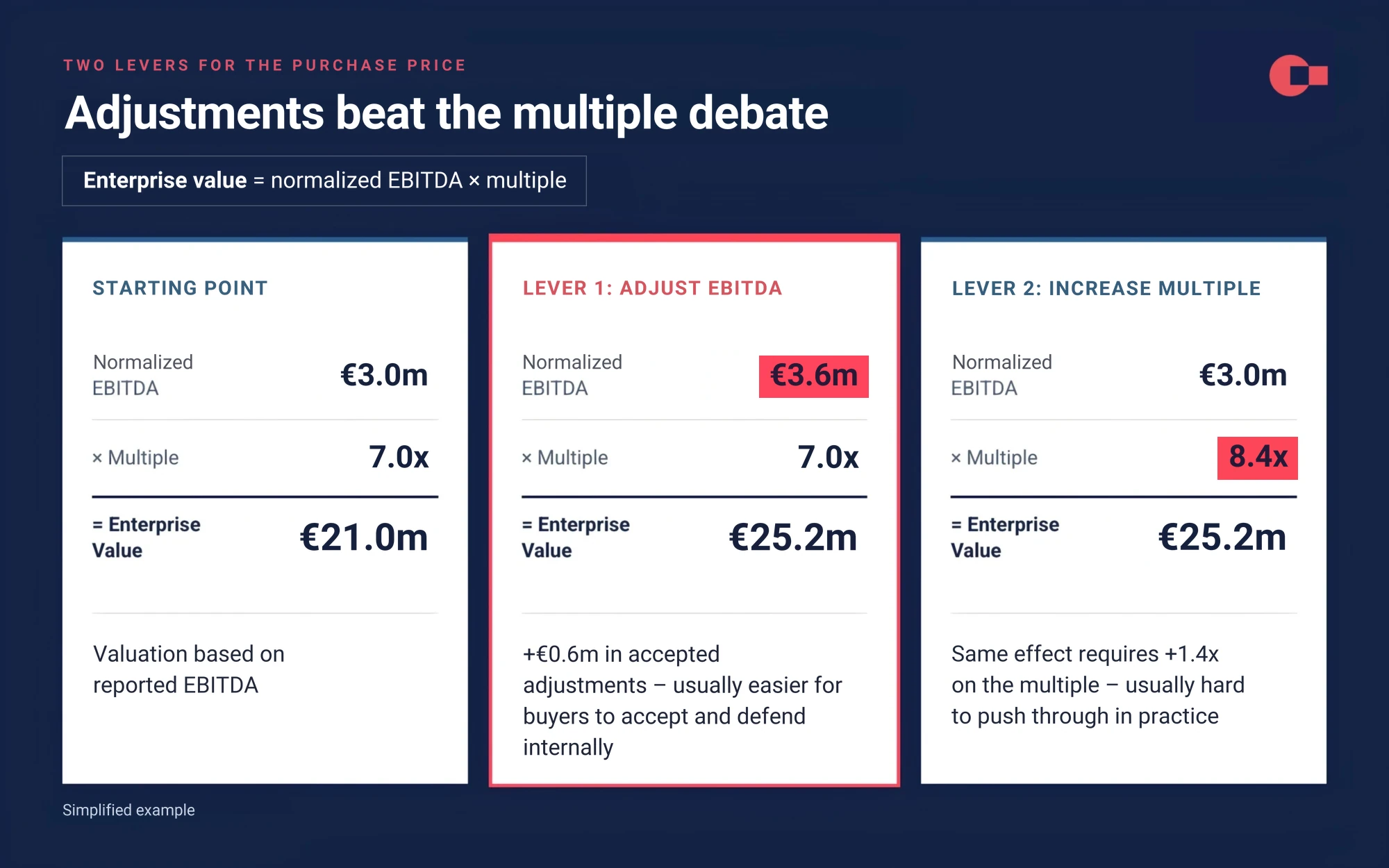
Enterprise value = normalized EBITDA × multiple
Enterprise value is stated on a cash-free, debt-free basis, i.e. without taking cash and financial debt into account. To get from enterprise value to the purchase price for the shares (equity value), financial debt, debt-like items and excess cash are typically offset. Depending on the deal, working capital is adjusted to an agreed target level. We explain how the various valuation methods work in detail in our article “Calculating Company Value: Methods, Rules of Thumb & the Buyer’s Perspective”.
The formula gives sellers two starting points:
- Increase the multiple: through convincing arguments, a strong equity story and good market prospects.
- Increase EBITDA: ideally through higher profits from operations and a careful adjustment of reported earnings.
Transaction experience shows that an attractive purchase price does not depend on the multiple alone. Deriving normalized EBITDA carefully is just as important. Well-founded, documented adjustments reflect true earnings power more accurately and therefore improve the valuation basis. At the same time, they can usually be explained and justified to buyers, investment committees and financing banks. Professionally prepared EBITDA therefore contributes significantly to realizing the full valuation potential in the sale process.
Adjusting too little gives away value, adjusting too much costs credibility.
We help you strike the right balance and justify every item.
The level of EBITDA also influences which buyers are interested in a company. For financial investors, companies often become particularly relevant from EBITDA of around EUR 2 million. Carlsquare’s transaction experience shows that above this level, or with more than EUR 5 million in recurring revenue, the likelihood of a successful sale increases significantly.
What is an EBITDA multiple and how high is it?
The EBITDA multiple shows how many times its EBITDA a company is valued at. It is derived from comparable listed companies or comparable transactions and then adjusted to the specific characteristics of the company concerned.
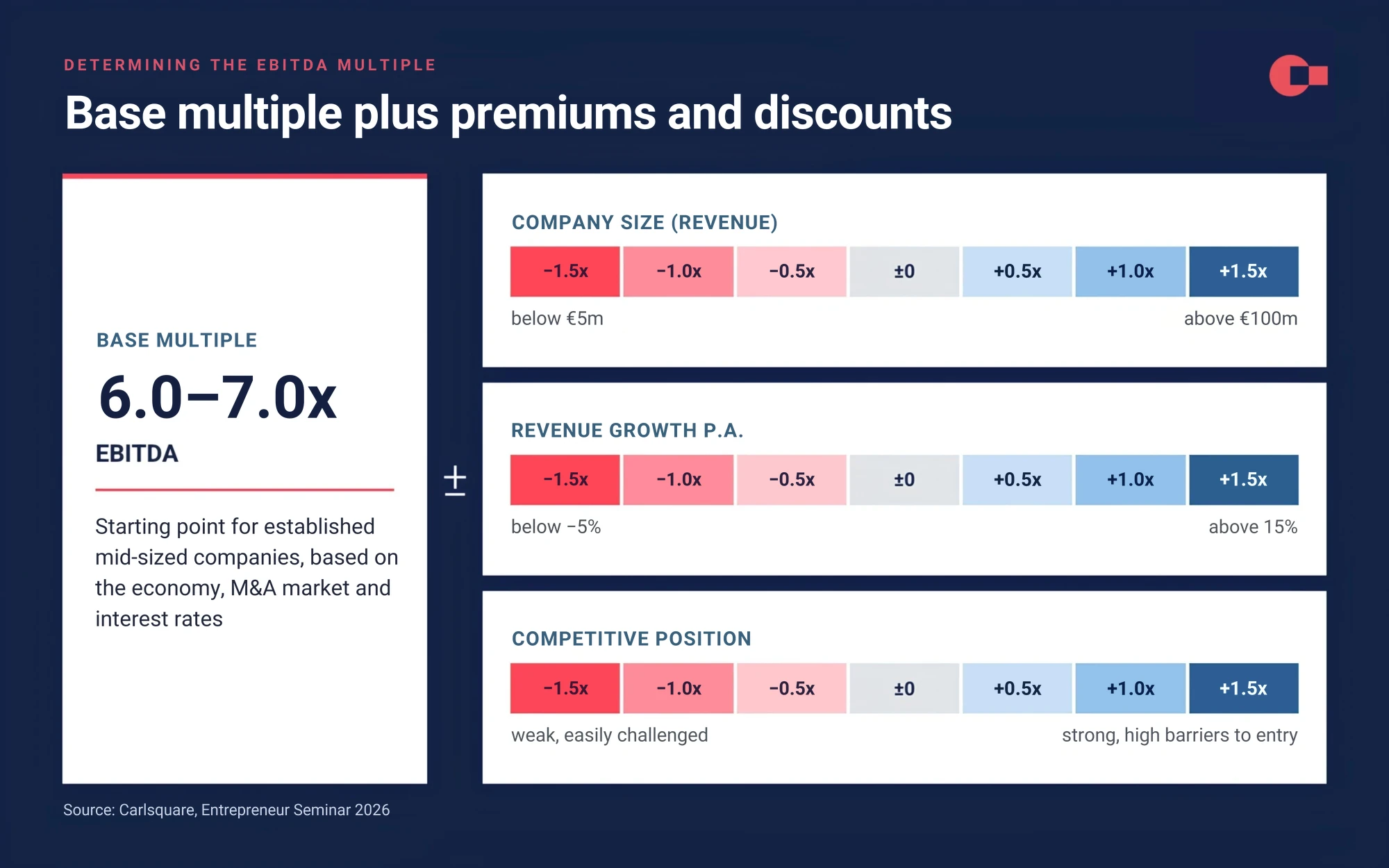
The starting point is a base multiple which, in practice, is usually in the range of 6.0 to 7.0x for established mid-sized companies. This figure is only a benchmark. The actual valuation depends on various factors. The most relevant are:
- Company size: With revenue below EUR 5 million, a discounted multiple is more likely, while companies with revenue above EUR 100 million are more likely to achieve a premium multiple. Larger companies often have a broader customer base and a lower risk profile.
- Revenue growth: If revenue shrinks by more than 5 percent, this can have a negative impact on the multiple. Growth of more than 15 percent, on the other hand, can justify a premium.
- EBITDA margin: A high margin compared with the industry supports the valuation, while a low margin tends to lead to a discount. A margin that is well above average will, however, be examined for its sustainability.
- Competitive position: A strong market position, high barriers to entry, technologies that are difficult to replicate, resilience to crises and high customer loyalty can have a positive effect on the valuation.
- Market environment: The current situation in the M&A market, the interest rate level and developments in the relevant industry also influence the achievable multiple.
A large addressable market, low dependence on individual sales channels, synergies with the buyer, high EBITDA-to-cash conversion and an experienced management team can also have a positive effect on the valuation. For company size, revenue growth and competitive position, Carlsquare applies premiums or discounts of up to 1.5x each relative to the base multiple as a benchmark.
However, the EBITDA multiple is not the right valuation metric for every company. For fast-growing companies that generate little or no EBITDA yet, revenue may be the more meaningful reference figure. As a rough guide: with growth of less than 30 percent, an EBITDA multiple is often used. Above that, a revenue-based valuation becomes more important.
This applies in particular to companies with a high share of recurring revenue. Financial investors mainly consider a revenue multiple when more than half of revenue is recurring and the company is growing by more than 30 percent at the same time. This constellation is common among companies in software and TMT.
Which multiples apply in which industry?
Valuation levels differ significantly between industries. FINANCE Magazin provides a regularly updated benchmark, publishing multiples based on assessments from M&A practice. The following overview shows EBIT multiples, not EBITDA multiples. Since EBITDA is higher than EBIT, the corresponding EBITDA multiples are lower.
| Industry | EBIT multiple small cap | EBIT multiple mid cap |
|---|---|---|
| Software/IT services | 8.0–10.0x | 9.8–12.0x |
| Medtech/healthcare | 7.8–9.4x | 8.9–11.0x |
| Renewable energy | 6.6–9.0x | 8.7–10.8x |
| Electrical engineering/digital industry | 7.0–8.8x | 8.0–9.8x |
| Cosmetics | 6.7–8.6x | 8.0–9.5x |
| E-commerce | 6.2–8.3x | 7.2–9.4x |
| Food and beverages | 6.2–7.4x | 7.4–8.2x |
| Consulting services | 5.5–7.5x | 7.0–8.1x |
| Mechanical and plant engineering | 5.5–7.0x | 6.0–7.9x |
Source: FINANCE Magazin, EBIT multiples for company valuation, January 2026 (excerpt)
Industry multiples provide good guidance for assessing company value. For a specific valuation, however, the individual strengths and prospects of a company also come into play, such as growth potential, market position, investment requirements and possible synergies with a buyer. Competition in the sale process, the deal structure and the allocation of risks also influence the achievable purchase price. In this way, the industry multiple becomes a valuation that reflects the situation and potential of the company.
What is adjusted EBITDA?
Adjusted or normalized EBITDA shows the operating earnings power a company achieves under normal conditions. To determine it, reported EBITDA is adjusted for special items that affect earnings on a one-off basis or are expected to cease after a change of ownership.
These may include one-off expenses, owner-related costs or other non-recurring effects. Adjusted EBITDA thus provides a basis for assessing the company’s sustainable earnings power as part of the valuation.
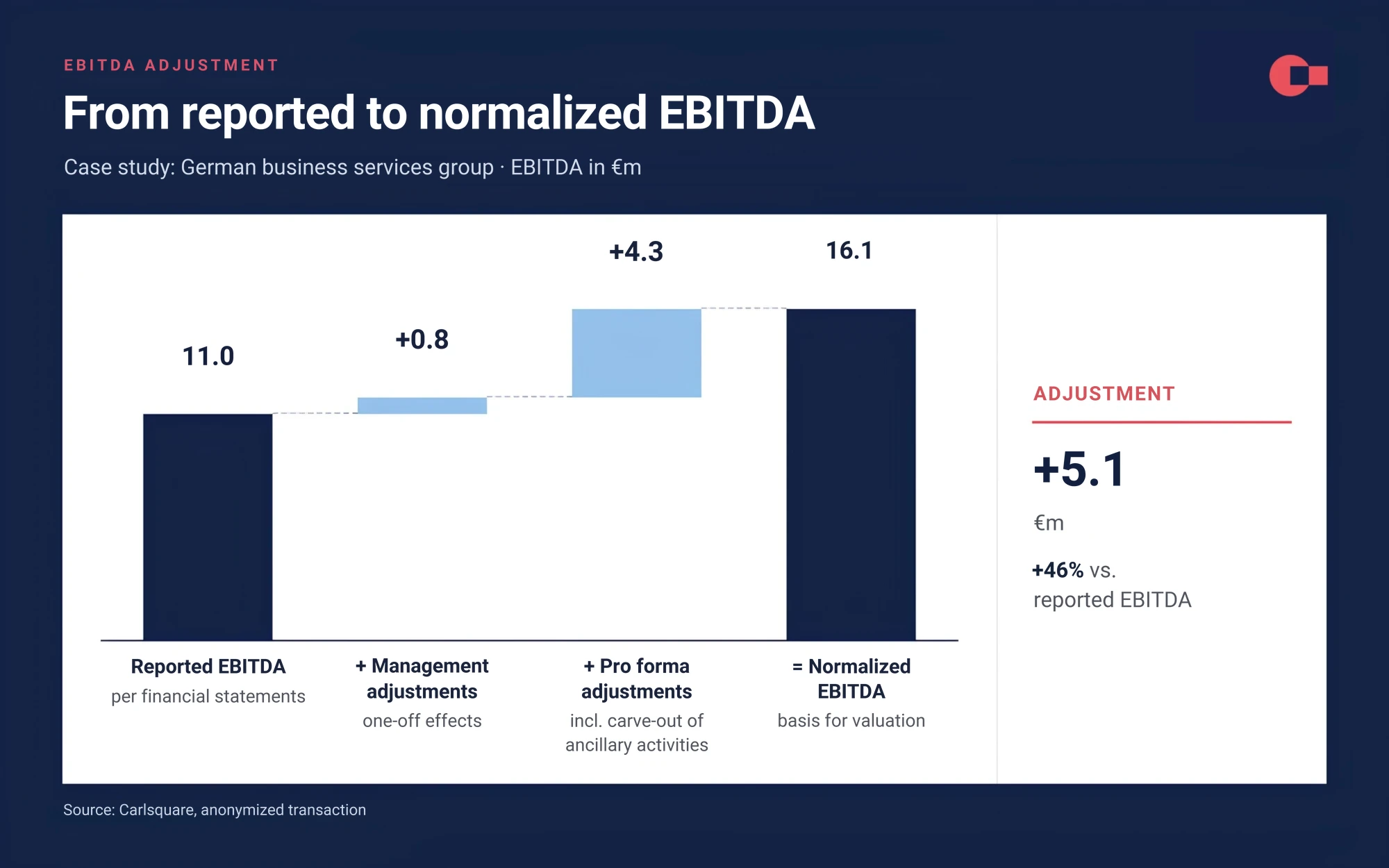
The adjustment is typically made in three steps:
- Reported EBITDA as the starting point: The calculation begins with EBITDA as reported in the annual financial statements.
- Management adjustments: One-off and non-recurring effects that do not reflect normal business are adjusted.
- Pro forma adjustments: Expenses that would not be incurred in a company that is not owner-managed, or within a larger group, are adjusted accordingly.
The result is normalized EBITDA, which forms the basis for the further valuation discussion. Synergies that only a buyer can realize are generally not included in the seller’s normalized EBITDA. They are a matter for the purchase price negotiation.
Normalized EBITDA can help bring together differing valuation expectations on the buyer and seller side. Alongside the multiple, the derivation of normalized EBITDA therefore offers another starting point in the purchase price negotiation.
How can EBITDA be optimized before a sale?
The most sustainable way to higher EBITDA is a more profitable business. Beyond that, there are levers that present reported earnings appropriately. Our article Increasing Company Value describes which other value drivers to address before a sale.
1. Understand accounting and present it appropriately
The type of accounting affects EBITDA. One example is the capitalization of internally developed software. If internally developed software is capitalized as an intangible asset, amortization increases, but EBITDA is relieved because it is measured before depreciation and amortization. Capitalization must be disclosed. Buyers usually normalize this effect again because the development costs continue to be incurred. The effect therefore changes the presentation, not the earnings power.
Under IFRS 15, incremental costs of obtaining a contract may, under certain conditions, be capitalized and spread over the contract term. Under German GAAP (HGB), this is generally not possible in the same way. How work in progress is accounted for also has an effect.
Buyers examine closely how items were booked during due diligence. The accounting and tax implications should therefore be agreed in advance with tax advisors and auditors.
2. Remove one-off expenses
Expenses that are incurred once and do not recur in the following year can be adjusted in the valuation year. Typical examples are the introduction of a new ERP system such as SAP or the insolvency of an important customer. In the case of a customer default, however, buyers check whether there is a concentration risk that could recur. The adjustment only works if the effect really was a one-off.
3. Adjust costs that cease with the transaction
Some expenses cease as soon as the company changes ownership, such as holding and group allocations or costs linked to the person of the shareholder. Synergies realized by a strategic buyer, on the other hand, do not belong in the seller’s adjustments. They are part of the purchase price negotiation.
4. Separate private and business matters
In owner-managed companies, private effects often find their way into earnings, for example unusually high or low salaries for family members working in the business, rents for properties owned by the entrepreneur or pension commitments. These effects are normalized so that earnings correspond to those of a company that is not owner-managed.
The earlier you prepare your EBITDA, the stronger your position in the purchase price negotiation.
Talk to us before the sale process begins.
Which items are typically adjusted?
The following list shows typical adjustment items. It is not exhaustive, as the items that apply in an individual case depend on the company. Adjustments can both increase and decrease earnings.
- Managing director salaries and bonuses: What would be the market-rate compensation for an employed managing director?
- Bad debts outside the ordinary course of business, for example due to the insolvency of a major customer, provided there is no recurring risk
- Special projects such as strategy projects or an SAP implementation
- One-off growth investments, provided they can be clearly separated and are not incurred on an ongoing basis
- Severance payments for employees or managing directors
- Proceeds and balance sheet effects from the sale of assets
- Rents that do not reflect market levels
- Holding or group allocations
- Advisory costs, for example in connection with the transaction
- Costs that will no longer be incurred after the transaction or will change
How far can an EBITDA adjustment go?
Adjustments are permissible if they are objectively justified. Overly aggressive items, however, cost credibility. Sellers who adjust too many items, or items that are difficult to document, lose the trust of buyers, and this can weigh on the entire negotiation.
Conversely, sellers who forgo justified adjustments often give away value. Comparable companies that a buyer is also looking at usually adjust their figures as well. Transparency is crucial: every adjustment should be derived and documented in a comprehensible way. Ideally, this is done before the sale process begins, for example as part of a vendor due diligence, and presented consistently in the information memorandum.
A simplified example shows what difference this can make: a company reports EBITDA of EUR 3.0 million and is valued at 7x, giving an enterprise value of EUR 21 million. If adjustments of EUR 0.6 million are accepted, enterprise value rises to EUR 25.2 million at the same multiple, an increase of EUR 4.2 million. To achieve the same effect through the multiple, the buyer would have to go from 7.0x to 8.4x, a step many buyers are not prepared to take.
What does an EBITDA adjustment achieve in practice?
Three anonymized transactions from Carlsquare’s advisory practice show how much normalized EBITDA can differ from reported earnings:
| Company | Reported EBITDA | Normalized EBITDA | Adjustment | Background |
|---|---|---|---|---|
| Business services group from Germany | EUR 11.0 million | EUR 16.1 million | + EUR 5.1 million (46%) | Different profitability of the units due to capacity expansion; ancillary activities were normalized as a carve-out item |
| Mid-sized services company | EUR 17.4 million | EUR 21.6 million | + EUR 4.2 million (24%) | Relatively high expenses for the shareholders were normalized as a hard adjustment |
| Company from the tourism sector | EUR 1.0 million | EUR 2.8 million | + EUR 1.8 million (180%) | Growth-related underperformance and reported EBITDA deliberately reduced for tax reasons |
The cases also show that buyers do not accept every adjustment. In these transactions, the final purchase price nevertheless remained unchanged compared with the letter of intent, even though individual items were not accepted. A well-founded adjustment calculation can therefore create room for negotiation, even if not every item is accepted in the end.
What role does EBITDA play in earn-out arrangements?
Alongside EBIT and revenue, EBITDA is one of the most common reference figures for an earn-out. Part of the purchase price is linked to achieving future EBITDA targets. Meeting the business plan is often a prerequisite for the full multiple: if the target is achieved, a multiple of 9x might apply, for example, while if it is missed, the multiple drops to 7x or 8x.
Because the term EBITDA leaves room for interpretation, the purchase agreement should specify exactly how the metric is calculated, which accounting principles apply and how one-off effects are treated.
Which year and which period are used to determine EBITDA?
The starting point is usually the most recent annual financial statements. For growing companies, however, performance in the current financial year is also tracked, and the valuation is then based on EBITDA for the last twelve months (LTM) or, the further the financial year has progressed, on the current year. This is often combined with an earn-out based on actual performance, while an initial payment is made when the transaction closes.
We would be happy to discuss which adjustments and valuation approaches may be relevant in your situation in an initial, no-obligation conversation.
Conclusion: EBITDA is often the most effective lever for the purchase price
In a company sale, EBITDA is one of the key reference figures for company value. Because buyers often show little flexibility on the multiple, the most effective lever for sellers frequently lies in EBITDA itself: in a profitable business, in an appropriate presentation of the figures and in a transparent, well-documented adjustment calculation.
Sellers who prepare their adjusted EBITDA early and transparently create a sound basis for the purchase price negotiation. Experienced M&A advisory can help identify the relevant adjustments, argue them convincingly to buyers and approach suitable buyer groups.
Frequently asked questions about EBITDA
What does EBITDA mean in simple terms?
EBITDA is a company’s earnings before interest, taxes, depreciation and amortization. The metric shows how much the operating business generates, regardless of how the company is financed, how much tax it pays and how much it has invested.
How do you calculate EBITDA?
EBITDA is calculated as net income plus taxes, interest expense (less interest income) and depreciation and amortization. Alternatively, it can be calculated from EBIT by adding back depreciation and amortization.
What is a good EBITDA multiple?
In Carlsquare’s experience, a base multiple of around 6 to 7x EBITDA serves as a benchmark for established mid-sized companies. Strong growth, a high margin, recurring revenue and a strong market position can lift the multiple to 8 to 10x and above, while smaller companies with weak growth tend to be valued at a discount. Actual figures vary considerably by industry and market phase.
What is a good EBITDA margin?
That depends heavily on the industry. As a benchmark from transaction practice: an EBITDA margin of more than 20 percent is one of the factors that can support a premium valuation, while margins below 10 percent tend to lead to a base valuation.
What is the difference between EBITDA and adjusted EBITDA?
EBITDA as reported in the annual financial statements (reported EBITDA) may also include one-off effects and owner-related costs. Adjusted EBITDA removes these effects and is intended to show sustainable operating earnings. In a company sale, adjusted EBITDA is usually the basis for the valuation discussion.
From what EBITDA level is a company attractive to financial investors?
Usually from EBITDA of around EUR 2 million. In Carlsquare’s experience, the likelihood of a successful sale increases significantly above this threshold or with more than EUR 5 million in recurring revenue. Below that, strategic buyers or succession solutions such as a management buy-out or management buy-in are more often an option.
Why are some companies valued on revenue rather than EBITDA?
For fast-growing companies that generate little or no EBITDA yet, EBITDA multiples are often not very meaningful. With growth of more than 30 percent and a high share of recurring revenue, a revenue multiple is therefore often applied, for example for SaaS companies.